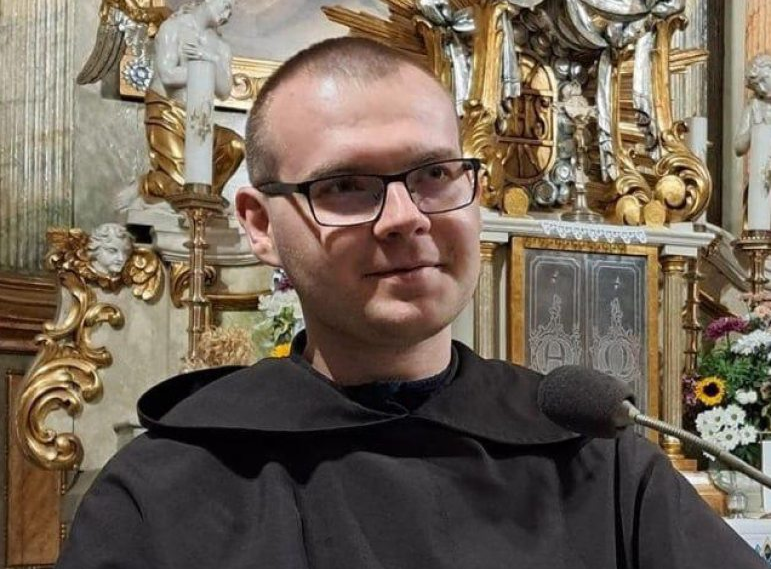
 A 27-year-old Polish Carmelite monk now sits in a Belarusian prison, facing a possible death sentence on suspicion of espionage after reportedly being found with a photocopy of a classified document related to the “Zapad-2025” war games involving the Russian nuclear weapons now stationed in Belarus.
On September 4, 2025, when Grzegorz Gawel was visiting the town of Lepel, north of Minsk, officers of the Belarusian State Security Committee (KGB) followed the monk into a town park and took video as he met an unidentified Belarusian man who handed him a sheaf of papers. Video of Gawel’s arrest minutes later was soon broadcast on state television to support the charge that he sought the sensitive papers on behalf of Polish state intelligence agencies. It was alleged he had “contacted a Belarusian citizen via social media and offered to cooperate with the Polish special services.”
Belarus authorities claimed Gawel enticed the man with coffee and chocolates, and said they had seized cash in multiple different currencies, bank cards, SIM cards, a rosary and “other religious items” from him. The unidentified Belarusian man was also arrested, but his fate is unknown.
Polish authorities denied they use clergy as spies, and called the arrest yet another provocation of a NATO member by Belarus, Russia’s dependent ally and recent host of Russian tactical nuclear weapons. Polish Catholic priests have been arrested in recent years and jailed in Belarus on various political charges.
Belarusian human rights campaigners now in exile in Lithuania and Poland have documented more than 1,000 political prisoners of the Lukashenko government, in addition to Gawel. He is the only one known to be facing charges related to nuclear weapons. Our House Centre for Human Rights and Relief, run by Belarusian exiles in Lithuania, says of Gawel that, “It is unclear whether he indeed tried to obtain and publish documents related to nuclear weapons, but if so, his actions can be seen as an important and heroic step in the fight for peace and security in the region.”
Our House continues that, “In the context of Belarus’s authoritarian regime, where truth is rarely achieved and where information is strictly controlled and manipulated by the state, exposing any sensitive information about the placement of Russian tactical nuclear weapons in Belarus is critical and necessary.”
Grzegorz Gawel is being held pending trial at the KGB detention centre in Minsk, known as “Amerikanka.”
He had taken his perpetual vows in the Carmelite Order in March, 2025, and served at the Basilica of the Visitation of the Blessed Virgin Mary in Krakow.
Belarusian human rights organizations, including Our House, have recognized Gawel as a political prisoner. Along with religious communities in Poland and the Polish Ministry of Foreign Affairs, these organizations are calling for consular access and his immediate release.
For more information, visit Our House’s website at ndbelarus.com/2025/12/03/polish-monk-detained-in-belarus-on-espionage-charges/.
Support Action
Letters of support should be sent to Grzegorz Gawel, KGB Pre-Trial Detention Center, 220040, Independence Avenue, 17, Minsk, Belarus. Olga Karatch of Our House shares this important reminder: “Letters to prisoners, even when they are censored or not delivered, still matter a great deal. They are read by prison staff and security services. They signal that this person is seen and has international attention. That can mean fewer beatings, fewer humiliations, and a genuine increase in the chances that he stays alive. So writing letters is not just moral support; it is also a way of influencing his treatment in prison and sometimes even the decisions made about his case.”
from Our House (scroll below)
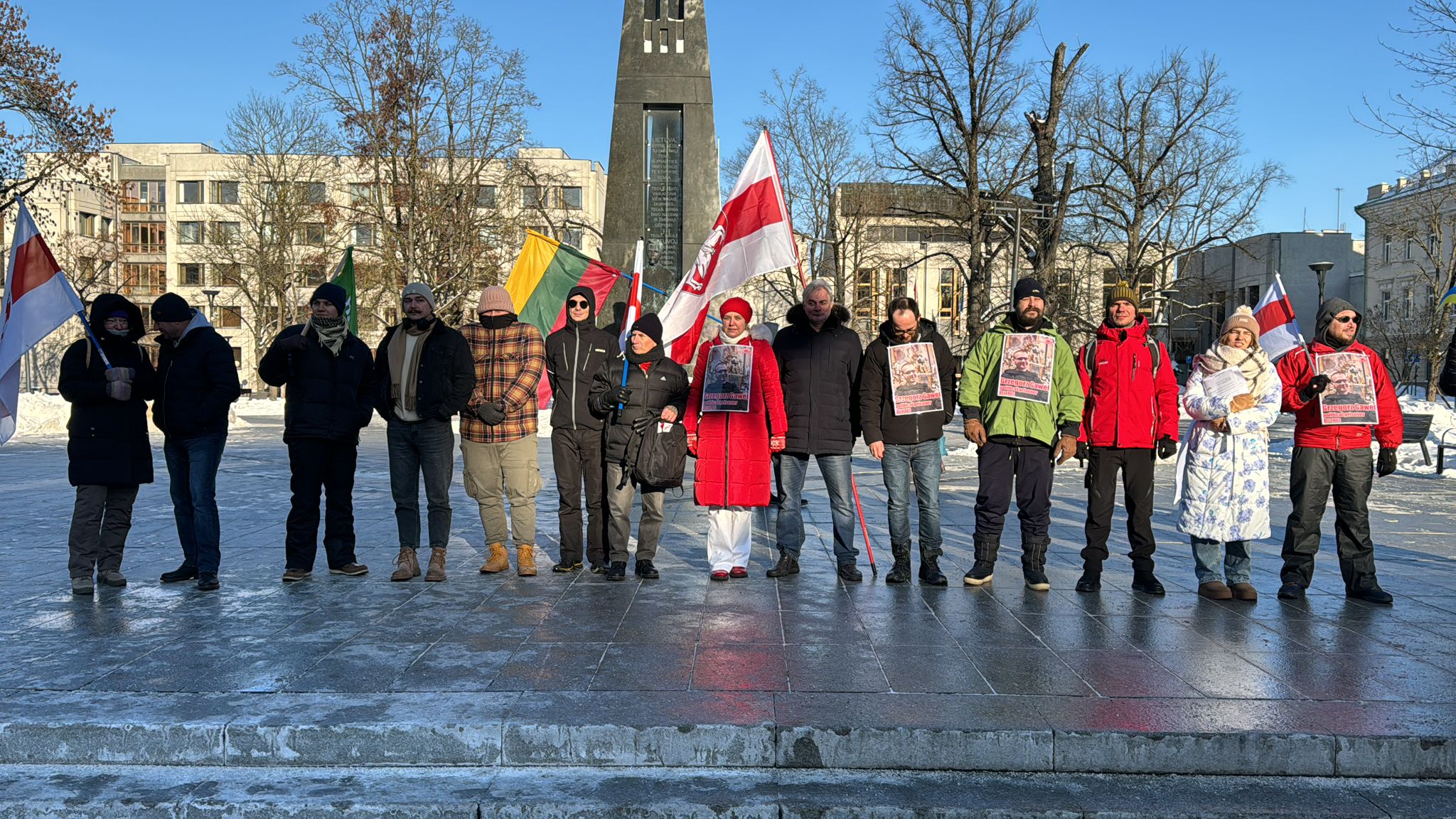
On 18 January 2026, within the framework of its weekly actions in support of Belarusian political prisoners, Our House held a solidarity action in Vilnius demanding the immediate release of Catholic monk Grzegorz Gawel, who is currently being illegally detained in the KGB detention centre in Minsk, known as “Amerikanka.”
Grzegorz Gawel was arrested in September 2025 and officially charged with “nuclear espionage” — allegedly for attempting to obtain documents concerning the deployment and characteristics of Russian nuclear weapons in Belarus. The state version of the обвинения appears unconvincing and politically motivated. At the same time, under such charges the monk may face the death penalty. We consider the Carmelite monk innocent and view his case as yet another example of the repressive use of “espionage” legislation against inconvenient individuals.
At the same time, Our House emphasises its fundamental position: nuclear weapons are not a state “secret,” but a global threat to all of us. They are capable of destroying humanity and causing irreversible damage to the planet and to our region. Therefore, there can and must be no “classified” information about nuclear weapons. Any data related to nuclear risks must be accessible to society, because it directly concerns the life, health, and safety of every person.
The right to information is a basic human right. Secrecy surrounding nuclear weapons serves not to protect people, but to preserve a system of irresponsibility.
Even if one assumes that Grzegorz Gawel was interested in such documents, the very attempt to obtain such critically important information cannot be considered a crime. It concerns the fate of millions of people — and first and foremost, us as Belarusians. In this sense, the persecution of a monk for seeking the truth about nuclear threats is an absurd and dangerous precedent.
We demand:
— the immediate release of monk Grzegorz Gawel;
— the termination of politically motivated criminal prosecution against him for alleged “nuclear espionage”;
— access for consular representatives;
— an end to the use of “espionage” charges as a tool of repression.
Nuclear weapons do not belong to states. Their consequences belong to all of humanity. Therefore, the truth about them must belong to everyone.
Freedom for Grzegorz Gaweł!
(In the photo: we are standing in –15°C frost to show our solidarity with the monk.)