
France arrests Greenpeace activists blocking arrival of uranium cargo ship from Russia
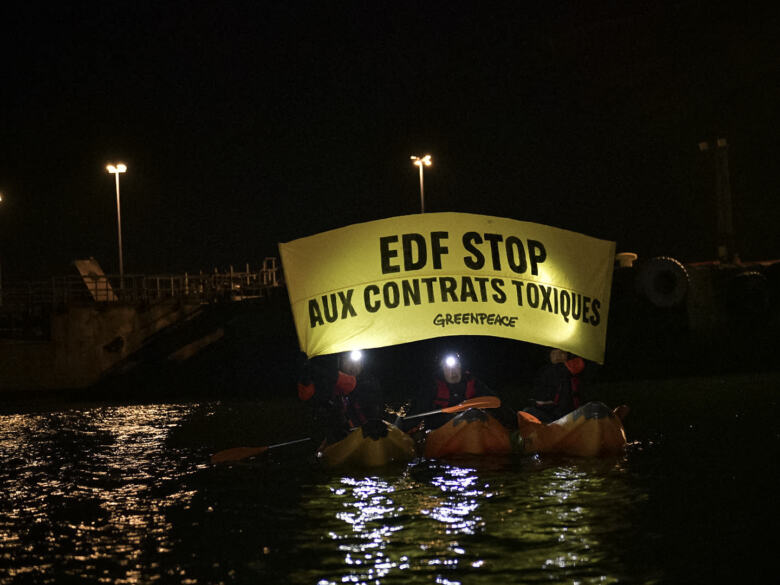
A cargo ship coming from Russia is blocked
from Greenpeace
March 2, 2026
This morning in the port of Dunkirk, around twenty Greenpeace activists blocked the arrival of the cargo ship Mikhail Dudin from Saint Petersburg to protest the nuclear trade between Russia and France. For two years, France has presented itself as a staunch supporter of Ukraine against the Russian aggressor. Yet, behind the scenes, the French nuclear industry (EDF, Framatome, and Orano) continues to do business with Rosatom, the Russian nuclear company complicit in war crimes.
Why block a cargo ship coming from Russia?
Stop toxic contracts
At 4:10 this morning, nearly 20 activists blocked a cargo ship arriving from Russia that usually carries uranium. This ship, the Mikhail Dudin, is a key player in the uranium trade between French and Russian industries. Almost four years to the day after the Ukrainian nuclear power plant in Zaporizhzhia was attacked and hijacked by Russian armed forces and then taken over by the Rosatom corporation, it is finally time to end this radioactive trade between this company, which has become criminal, and the French industrial giants EDF, Framatome, and Orano.
Despite the support shown and provided to Ukraine by the French government since the beginning of Russia’s global invasion of Ukraine, the President of the Republic actively supports the continuation of this scandalous trade. Greenpeace France has consistently documented these uranium shipments arriving and departing from the port of Dunkirk through regular investigations.
Rosatom is not a Russian company like any other. Because it is the world’s largest supplier of nuclear power plants currently under construction, it serves Putin’s regime as a tool of geopolitical power. According to the Ukrainian NGO Truth Hounds, whose visit to France was organized by Greenpeace last week, Rosatom has been complicit in war crimes at the Zaporizhzhia nuclear power plant in Ukraine: torture of Ukrainian employees, repression of civilians, and endangering nuclear safety.
The ballet of cargo ships loaded with uranium has never ceased, and this new arrival takes place just a few days after the commemoration of four years of war in Ukraine and a few days before that of the capture of Zaporizhzhia by the Russian army, on March 4, 2022.
While the European Union has imposed sanctions on Russia since the beginning of the war, particularly in the energy sector ( Russian gas and oil ), neither the nuclear sector nor the Rosatom corporation are subject to these sanctions, largely thanks to lobbying by France and Hungary . The French state must be held accountable; these practices are unacceptable.
“This trade, which indirectly fuels Putin’s war, must stop. On numerous occasions, we have observed the unloading of Russian enriched uranium or natural uranium from this cargo ship. What’s inside it now? Only Orano, EDF, and/or Framatome know for the moment. Given the opacity of this trafficking, the truth about this trade must be revealed.”
– Pauline Boyer, nuclear campaign manager for Greenpeace France
EDF, Framatome, Orano: what are their responsibilities?
EDF, Framatome, and Orano are the three leading public companies of the French nuclear industry. Their influence is enormous, both in France and internationally, and their involvement in trade with Russia places them at the heart of the scandal.
EDF (Electricité de France): world leader in nuclear electricity production, EDF operates the 57 French reactors and buys all of its uranium from abroad, including from Russia.
Framatome (a subsidiary of EDF): a specialist in nuclear technologies, it designs and maintains reactors, and also provides equipment and services to Rosatom, thus reinforcing technological and energy dependence on Russia, the world’s leading builder of nuclear power plants abroad.
Orano (formerly Areva): a giant in the fuel cycle, Orano extracts, enriches, and recycles uranium. Despite the war, the company maintained uranium imports: nearly half of France’s annual natural uranium imports come from Kazakhstan and Uzbekistan and transit through Russian territory, under the control of Rosatom. Without Rosatom, Orano would not receive half of the uranium it handles each year.
Together, these three companies form a network of influence and dependence that directly benefits Rosatom – and therefore indirectly benefits the Russian war machine. Their silence in the face of Greenpeace France’s appeals is unacceptable.
Fueled by the government’s misleading argument that nuclear energy would achieve energy independence, the nuclear industry continues to maintain commercial ties with Rosatom. Yet, if France played a significant role in preventing any sanctions against Rosatom at the European level, it is precisely because the French nuclear industry is dependent on Russia. The supposed French energy independence through nuclear power is a myth.
Red carpet for nuclear power against all odds
With the World Nuclear Summit (a meeting of heads of state to promote nuclear power globally) taking place in Paris on March 10, France is preparing to offer an international platform to the nuclear industry… and therefore to Rosatom.
Worse still: this summit risks offering him a veneer of respectability, allowing Vladimir Putin to continue exporting his influence – and financing his war – under the guise of an “energy transition.” By hosting this event, France becomes complicit in this charade.
Time for responsibilities
The French government and the French nuclear industry (EDF, Framatome, Orano) owe explanations to the French and Ukrainian people. This is why Greenpeace France is asking the French government:
- to shed light and ensure transparency on the uranium trade.
- to demand that the companies EDF (of which it is the majority shareholder), Orano and Framatome terminate their contracts or business relationships with Rosatom.
- to end collaborations between its institutions, the French nuclear industry and Rosatom.
- to cease preventing sanctions against Rosatom at the European level, and to work actively towards its inclusion on the list of entities targeted by European sanctions against Russia.
xxx
France arrests activists blocking ship over alleged Russia uranium links
Mon, 2 March 2026 at 3:35 am GMT-7
The Russian ship Mikhail Dudin docks at the port of Dunkirk, northern France, 13 September, 2022.
(AP – Michel Spingler)
Around 20 protestors carrying signs reading “Stop toxic contracts” and “Solidarity with Ukrainians”, blockaded the Mikhail Dudin at the northern port of Dunkirk early on Monday morning, to prevent it from unloading its cargo, a journalist from French news agency AFP observed.
French authorities then arrested four individuals, Dunkirk police told AFP, adding that the blockade was lifted around 9 am local time.
Greenpeace has repeatedly accused France of maintaining ties with Russia’s state-owned energy company, Rosatom, despite President Vladimir Putin’s war in Ukraine.
Activists, some on kayaks, had impeded the ship while a large banner stretched across the lock read, “Uranium: EDF loves Putin” – a jab at the French state-owned energy giant.
In 2018, France’s EDF signed a 600-million-euro deal with a Rosatom subsidiary, Tenex, for reprocessed uranium from French nuclear power plants to be sent to Russia to be converted and then re-enriched before being reused in power production.
Greenpeace claims French resumption of nuclear trade with Russia
Rosatom has the only facility in the world – in Seversk in Siberia – capable of carrying out key parts of the conversion of reprocessed uranium to enriched reprocessed uranium.
“This trade, which indirectly fuels Putin’s war, must stop,” said Pauline Boyer, an energy campaigner for Greenpeace France on Monday.
The environment group alleges it has “on numerous occasions” observed the Mikhail Dudin unloading Russian natural and enriched uranium in France.
An AFP analysis of Global Fishing Watch tracking data shows the Mikhail Dudin has made more than 20 round trips between Dunkirk and the Russian ports of Vistino, Ust-Luga and Saint Petersburg since Russia’s full-scale invasion of Ukraine began on 24 February, 2022.
The Baltiyskiy-202 – another vessel that Greenpeace alleges has transported uranium between France and Russia – has completed more than 15 round trips during the same period.
Both sail under the Panamanian flag and are owned by companies registered in Hong Kong, according to the International Maritime Organisation’s register.
EDF did not immediately respond to AFP’s request for comment.
In 2022, France ordered EDF to halt its uranium trade with Rosatom when Greenpeace first revealed the contracts in the wake of Russia’s invasion.
But in March 2024, Jean-Michel Quilichini, head of the nuclear fuel division at EDF, said the company planned to continue to “honour” its 2018 contract.
France in March 2024 said it was “seriously” looking at the possibility of building its own conversion facility to produce enriched reprocessed uranium.
AFP analysis of French customs data shows that in 2025, France imported at least 112 tonnes of enriched uranium and its compounds from Russia, accounting for a quarter of total purchases by volume – a level stable compared to 2024.
These imports however fell significantly between 2022 and 2024.